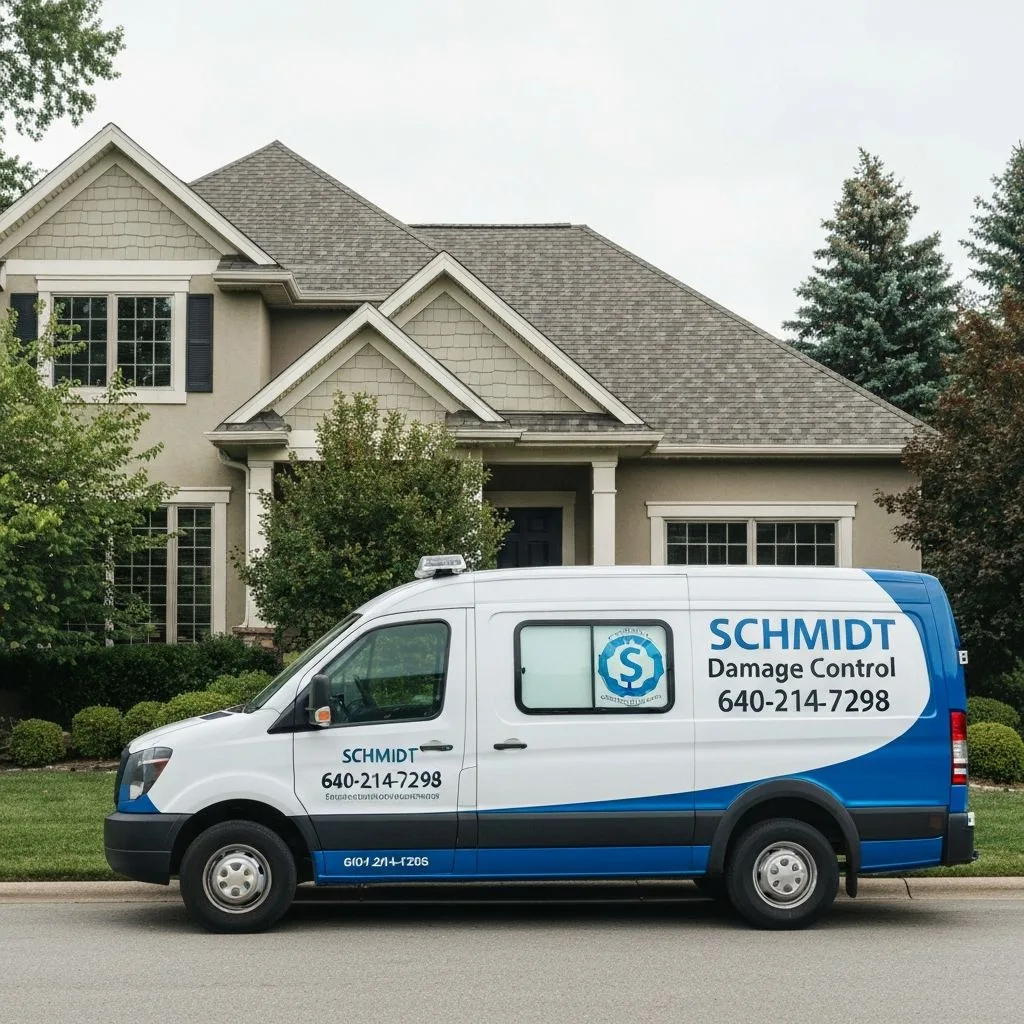
Water has a way of finding the lowest, least visible path through a Princeton building, which is exactly why a small leak turns into a large loss. Schmidt Damage Control shows up with calibrated meters and high-volume extraction gear, then maps the full wet footprint before deciding what to pull and what to dry in place. Older Mercer County housing with original plumbing reacts differently to a soaking than newer construction, and we adjust the scope to match. We capture the wet boundary, the demolition performed, and the final clearance numbers so no part of the claim relies on memory. Call 640-214-7298 and a Mercer County team heads out without delay.
- 24/7 emergency dispatch
- Truck-mounted extraction
- Industrial drying equipment
- Daily moisture documentation
- Insurance scope-aligned reconstruction
- IICRC S500 protocol
Why The Meter Beats The Eye
Most of the cost in a water loss is set by what soaks in, not what pools up. Drywall wicks moisture upward, the subfloor holds it underneath, and insulation traps it against the framing — so a quick mop leaves most of the loss in place.
We locate the saturation with moisture meters and thermal imaging, then size the drying equipment to the cubic footage rather than guessing. The whole job is documented — moisture maps, equipment placement, daily readings — and handed over as a complete claim packet.
The Drying Standard We Hold To
Different materials reach dry at different points, so each one is metered separately. Air movers and dehumidifiers are placed to the assembly, then repositioned as the readings dictate over successive days.
Most residential losses dry in three to five days; dense or older construction can push that to seven or ten. Verified-dry on paper is what keeps the rebuild from sitting on top of moisture that was never resolved.
Water Damage Restoration and the rest of your recovery
A property loss in Princeton rarely stays in one lane — water damage restoration often overlaps with soot removal, severe weather recovery, mold inspection and removal, Category-3 water cleanup, structural rebuild, and our crew handles all of it under one contract. We dispatch the same standard to Trenton water damage restoration, Water Damage Restoration in Plainsboro, Lawrence Township water damage restoration, West Windsor water damage restoration and everywhere else across Mercer County.
If you searched for restoration company near Princeton, you have reached a local team — call 640-214-7298 any hour. For background, read Sewage Backup in a Princeton Basement: Why It Happens in Mercer County and What Comes Next on our blog, or head back to our Princeton home page to see everything we do.